Chapter 1
Objectives - Early Colonies have mixed success
1.3.1. To describe early English attempt at colonizing:
Colonists settled British North America for different reasons, the main ones were religious freedom and profit. For those colonies, who came for profit, there were granted charters to venturing proprietors or joint-stock companies, by the British Crown. But whatever the type of colony and the reason for coming was, when English settlers arrived they encountered native populations and Spanish and French settlements. The first expedition was led by John Carbot, with the goal to find a sea route to trade with Asia. He did not find anything that, for him, was migration worth, so England did not try the next 80 years. In 1585, Sir Walter Raleigh set up a colony of about 100 men. They took one of the first English settlement attempts. On the east coast of North America, Sir Walter Raleigh named the land Virginia, after Queen Elizabeth I, who was known as “Virgin Queen” because she was unmarried.
1.3.2. To explain English Financing of a colony
The colonies realized that they had to find something to finance themselves, they started growing tobacco. In Europe at the same time the popularity of smoking grew, so they already found a place to sell their tobacco. Also they had slaves and everybody, who would come over and stay for seven years and work, was offered free land.
1.3.3. to summarize how Jamestown was founded and grew
In 1607, 144 men were send by King James I to Virginia to start a settlement. The 104 men, who survived, founded Jamestown. Jamestown is named after their King James I. Jamestown was the first permanent settlement of the British in North America. n its early years, the settlers at Jamestown experienced an extremely high mortality rate, the lack of food actually leading some of the settlers to resort to cannibalism during the winter of 1609-1610, this period becoming known as the “starving time.” In 1609, 400 more settlers arrived, and because they did not have enough food, they stole food from the Native Americans. The Native Americans attack them, because of that. The following winter only 60 people survived. Than they started their tobacco plantation and could finance themselves. 1620 Jamestown was so big that they had to found another town next to it.
1.3.4. to analyze the conflicts of the Jamestown colonists both with Native Americans and among the colonists themselves.
Because the English settlers had no knowledge about living in the wild, they started stealing from the Native American. In return the Native Americans attack Jamestown. Later Jamestown grew so fast and was so big, that the Native Americans were afraid so they attack Jamestown and killed 350 settlers.
Objectives - New England
1.4.1. To explain why pilgrims established Plymouth Colony
The members of the English Separatist Church-set, who were known as the Pilgrims and were labeled as Separatists, sailed abroad the Mayflower to the New world. The reason was that, in their opinion the Anglican Church could not be reformed. And rather than attempting to purify the church, the Pilgrims desired a total separation.
1.4.2. to explain why the Puritans set up Massachusetts Bay Colony
The Puritans were a religious group and wanted to change the church of England and did not want separate as the Pilgrims. The Puritans wanted to make the Church more pure by removing ceremony and music. In 1628, a group of Puritans formed the New England Company. The King of England gave them a charter to make a settlement along the Massachusetts Bay. The first group of Puritan settlers was led by John Endecott. They began to settlement Salem, Massachusetts. The Puritans were allowed to make their own laws. The Puritans came to America to practice their religion as they pleased. Freedom of Religion was not the law in the Massachusetts Bay Colony.
1.4.3. to identify the new England way and to evaluate challenges to Puritan leadership
New England way refers to the ecclesiastical polity, relation to the civil powers, and general practices of the Massachusetts Bay Colony churches and, sometimes, to those of Connecticut or Rhode Island. The Puritans work on suppress other religions and other religious beliefs, which had the effect that other colonies were founded.
1.4.4. to summarize the causes and effects of King Phillip’s War and the Salem witchcraft
Colonial families often had eight or more children. Puritans believed that parents must instill self-control in their children, so they would accept the discipline of the Lord. Reading, important for understanding the Bible, was generally taught at home. There was no official school in the Colony until the 1670s. Children did not have much time to play. Girls worked in the house with their mothers; boys worked with their fathers in the field or the workshop. King Philip’s War resulted in the destruction of families and communities, Native and colonist alike, throughout New England. It took decades for the colonists to recover from the loss of life, the property damage and the huge military expenditures. The war was devastating for Native Peoples. Entire families were sold into slavery abroad; others were forced to become servants locally. The Wampanoag had to adapt aspects of their culture to survive; their political independence ended. Nevertheless, Native Peoples continued to live in Plymouth Colony. Many maintained tribal ties and a strong sense of community.
1.5 objectives - Founding the middle and southern colonies
1.5.1. To compare the founding the middle colonies:
The Middle Colonies. William Penn paid 1200 pounds for the land he purchased from the Delaware Indians. Americans have often prided themselves on their rich diversity. Nowhere was that diversity more evident in pre-Revolutionary America than in the middle colonies of Pennsylvania, New York, New Jersey, and Delaware. Pennsjlvania and Delaware were founded by the Quarkers. New York and New Jersey were taken by the Dutch.
1.5.2. To trace the growth of the middle colonies
1.5.3.To explain how economics influenced the development of the southern colonies
The Southern Colonies concentrated on agriculture and developed the plantations exporting tobacco, cotton, corn, vegetables, grain, fruit and livestock. The Southern Colonies had the largest slave population who worked on the Slave Plantations. Plantations grew cotton, tobacco and other crops.
1.5.4. To identify unique reasons for the founding of Georgia and Maryland
Specific groups of colonists founded Georgia and Maryland as refuge. Georgia was founded by James Oglethorpe and was a colony for poor people to start over. Maryland was established in 1634 by Lord Baltimore as a refuge for Catholics.
Chapter 2
Poem about the Declaration of Independence
The Declaration of Independence is free, important, independent, historic and old
This affects the all citizens of America
It residents in the National Archives
It relates to the 17th hundreds
These people lived in colonies
These people searched for freedom
This document taught that they were independent
And remembered as the foundation of the United States of America
Felt like a new beginning
Most important significance was the birth of the Nation
9/11 Timeline
http://kayaushistory.yolasite.com
Presentation
http://prezi.com/qt2rpap0absz/?utm_campaign=share&utm_medium=copy&rc=ex0share
Chapter 5
Marbury vs. Madison
1800 Thomas Jefferson won the presidential elections against, the at that time president, John Adams. Even though the result was already made on the 17th of February 1801 Adams stood president until the 4th of march 1801. The second last day of Adams presidency he appointed 42 federalists to new judges. On the 4th of March, when Jefferson became president, he called 25 of the 42 certificates of appointment void. He appointed James Madison to the new Secretary of state and told him to do not block the certificates. As reaction to that, Marbury complaint, that Madison, beause of the writ of mandamus has to block the certificates of appointment, so they become valid. Marbury was appointed as the secretary of peace, but his appointment was, because of Jeffersons command, not delivered. Marbury went straight to the Supreme Court, to force the new secretary of peace (Madison) to deliver the appointments. On the 24th of February 1803 the supreme court decided that in this case there was no jurisdiction and justified that with three questions:
- Did Marbury had a right to receive his appointment?
- If he had the right, did the right give him the appeal he needed?
- Is asking the Supreme Court for a writ of mandamus the correct legal remedy?
This case created the judicial review, which allows the court to declare state laws void.
Chapter 6 Vocabulary and Work
Suffrage: the right to vote
Spoils System: the practice of giving people government jobs on basis of their party loyalty
Caucus System: restricted nominations to the elite and well-connected
Secede: withdraw
Tariff of Abominations: new trading tariff in 1828
Daniel Webster: from Massachusetts, had a confrontation with Robert Hayne on the floor of the Senate
Force of Bill: passed 1833, authorizing the president to use die militia to enforce acts of Congress
Indian Removal Act: pushed through 1835 by Jackson, provided money for relocated Native Americans
Trail of Tears: many people died, while they were relocated, on their way, through now Oklahoma, which is now known as trail of tears.
Panic of 1837: After Van Buren took office a crippling economic crisis hits the nation, many banks and businesses failed, now known as panic of 1837
Nativism: the presence of people from different cultures, with different languages and religions, produced feelings of nativism, or hostility toward foreigners
Utopia: Some Americans in 1830s concluded the society had corrupted human nature. They decided that the solution was to separate from society and form utopia, or ideal society
Romanticism: movement that began in the late 1700s in Europe, advocated feeling over reason, inner spirituality over external rules, the individual over society and nature over environment created by human
Transcendentalism: urged people to transcend, or overcome, the limits of their minds and let their souls reach out to embrace the beauty of the universe
Know-Nothings: Membership in the party was secret, and they questioned about it were obliged to answer “I know nothing”
Second Great Awakening: a movement in the early 1800s to revive people’s commitment to religion
Charles Grandison Finney: one of the most famous advocates and Presbyterian minister
Joseph Smith: New Englander living in New York, preached Mormon ideas in 1830s after claiming to have been called to restore the Christian Church to its original form
Benevolent society: an association to spread the word of god and attempting to convert nonbelievers, however changed to sought to combat a number of social problems
Temperance: moderation in the consumption of alcohol
Penitentiary: a new prison, where prisoner meditate to think about their wrongdoings, expressed the idea that they were places where prisoners would work to achieve penitence, or remorse
Dorothea Dix: schoolteacher, began a crusade to improve conditions for mentally ill and provide them with the facility and treatment they needed in prison
Lyman Beecher: prominent minister, insisted that it was the nations citizenry, more than its government, that should take charge of building a better society
Horace Mann: Massachusetts legislator, leader of movement for public education
Elizabeth Cady Stanton: organized with Lucretia Mott active in antislavery movement, organized the Seneca Falls Convention
Seneca Falls Convention: antislavery movement organized by Lucretia Mott and Elizabeth Cady Stanton
Gradualism: approach supported by antislavery society
Abolition: new idea in 1830 by antislavery groups
Emancipation: freeing somebody from slavery
American Anti-Slavery Society: Membership founded in 1833 by Garrison
William Lloyd Garrison: put effort in a large movement in the 1830s
American Colonization Society: antislavery reformers founded it to move African Americans back to Africa.
Frederick Douglass: one of the most famous prominent African Americans in the abolitionist movement
Sojourner Truth: An African American abolitionist
Nr. 1: According to the third resolution, what is the duty of American woman?
Their duty is to secure themselves and their sacred right to the elective franchise.
Nr. 2: What does the declaration ask all women to do?
- to be self-evident
- women and men are equal
- to stand up for themselves
- don't let man tyranny over them
Timeline Civil War
12th of April 1861, the first battle of Fort Sumter
Confederate forces under General P.G.T. Beauregard bombard Major Robert Anderson and his Union soldiers at Fort Sumter in Charleston, South Carolina. The Civil War officially begins. The bombardment lasted for 34 hours striaght, until the Union soldiers surrendered. Surprisingly, no soldiers on either side were killed by enemy fire.
21st of July 1861, the first battle of bull run
The First Battle of Bull Run pits Union General Irvin McDowell against the new Confederate army. McDowell is defeated causing a panicked retreat back to Washington, which is about forty miles away. The withdrawal is hampered by the large numbers of spectators who are there to see the battle.
16th of February 1862, battles of Fort Henry and Fort Donelson in Tennessee
Both of these battles happened in the same month 10 miles apart from eachother. The Confederate’s Fort Henry fell on Feb 5th, General Ulysses S. Grant‘s troops and 7 gunboats from the Union began shelling the fort. The Confederate troops evacuated Fort Henry and moved to Fort Donelson 10 miles away, and Grant’s troops followed them. Union casualties were 2,331 while the Confederacy suffered more than 15,000. The Union could now head south through Tennessee. This was the Unions first victory.
8th of March 1862, battle of the Monitor and the Merrimack
The Confederate ironclad USS Merrimack battles the Union ironclad USS Monitor in Chesapeake Bay. The battle is a draw but it makes wooden ships obsolete and ushers in the era of steel warships, changing naval warfare forever.
8th of April 1861, Battle of Shiloh
Union General Ulysses S. Grant's forces are surprised at the town of Shiloh in Tennessee. The ensuing battle results in 13,000 Union and 10,000 Confederate casualties, more than in all previous American wars combined.
13th April 1862, battle and capture of New Orleans
The Capture of New Orleans by Union forces was a major turning point in the war. New Orleans was the Confederacy’s largest city, and, given its location at the mouth of the Mississippi River, a trading location with a powerful and economical port.
17th of September 1862, The Battle of Antietam
The Battle of Antietam is the bloodiest day in United States history. Over 26,000 men are killed, wounded or missing in action on both sides. Though officially a draw, the battle stops General Robert E. Lee's invasion of Maryland and he retreats back to Virginia.
1st of January 1863, the Emancipation Proclamation
Lincoln issues the Emancipation Proclamation. It frees all slaves in territory captured by the Union Army, and orders the enlistment of black soldiers. From this point forward, the Civil War is a war over slavery.
1st of July 1863, Battle of Gettysburg
From July 1 to July 4, the Union Army under General Meade defeats Robert E. Lee's Confederate Army at Gettysburg, Pennsylvania. One of the bloodiest battles of the war, Gettysburg is a turning point, and marks the farthest advance of the Confederate Army into northern territory.
19th of September 1863, Gettysburg Address
President Lincoln delivers the two-minute Gettysburg Address at the dedication of the National Cemetery at the battlefield in Gettysburg, Pennsylvania, to honor the soldiers, who died.
4th of November 1863, Lincoln wins elections again
Sherman’s victory in Atlanta boosted Lincoln’s popularity and helped him win re-election. This was a very important moment in the war.
9th of April 1865, Lees surrender and Lincolns dead
General Robert E. Lee surrenders to General Ulysses S. Grant in a farmhouse in the town of Appomattox Court House, Virginia. The war is over.Abraham Lincoln is shot by John Wilkes Booth at Ford's Theater in Washington, D.C. Lincoln does not regain consciousness after being shot at Ford's Theater. He dies from his wound.
Indians of the Plains
1. 3 policies the US. Government try with the Plains Indians
Northwest Ordinance of 1787, Dawes Act, Indian Removal Act
2. What happened at Sand Creek, Colorado in 1864?
On November 29, 1864, seven hundred members of the Colorado Territory militia embarked on an attack of Cheyenne and Arapaho Indian villages. The militia was led by U.S. Army Col. John Chivington, a Methodist preacher, as well as a freemason.
3. What was the last Indian battle of the 1800's?
The last indian battle of the 1800s was known as the Wounded Knee Massacre. It took place on the 29th of December 1890near Wounded Knee Creek.
4. What was the Dawes Act? Why did it fail to achieve its goal?
Dawes Act of 1887 definition. A federal law intended to turn Native Americans into farmers and landowners by providing cooperating families with 160 acres of reservation land for farming or 320 acres for grazing. Despite intending to expand property ownership for Native Americans, the Dawes Act of 1887 failed to establish positive changes, and met resistance from Native Americans. Drafted by Senator Henry Dawes, the Dawes Act went into effect on February 8, 1887.
Miners and Lumberin
1. What two precious metals lured miners to the West?
Gold and Silver lured miners to the West.
2. What natural resources of the Pacific Region offered opportunities to Western settlers?
silver, gold, cooper and lead
Pacific Region: Alaska, California, Hawaii, Oregon, Washington
3. Give the Location of the famous mining centers:
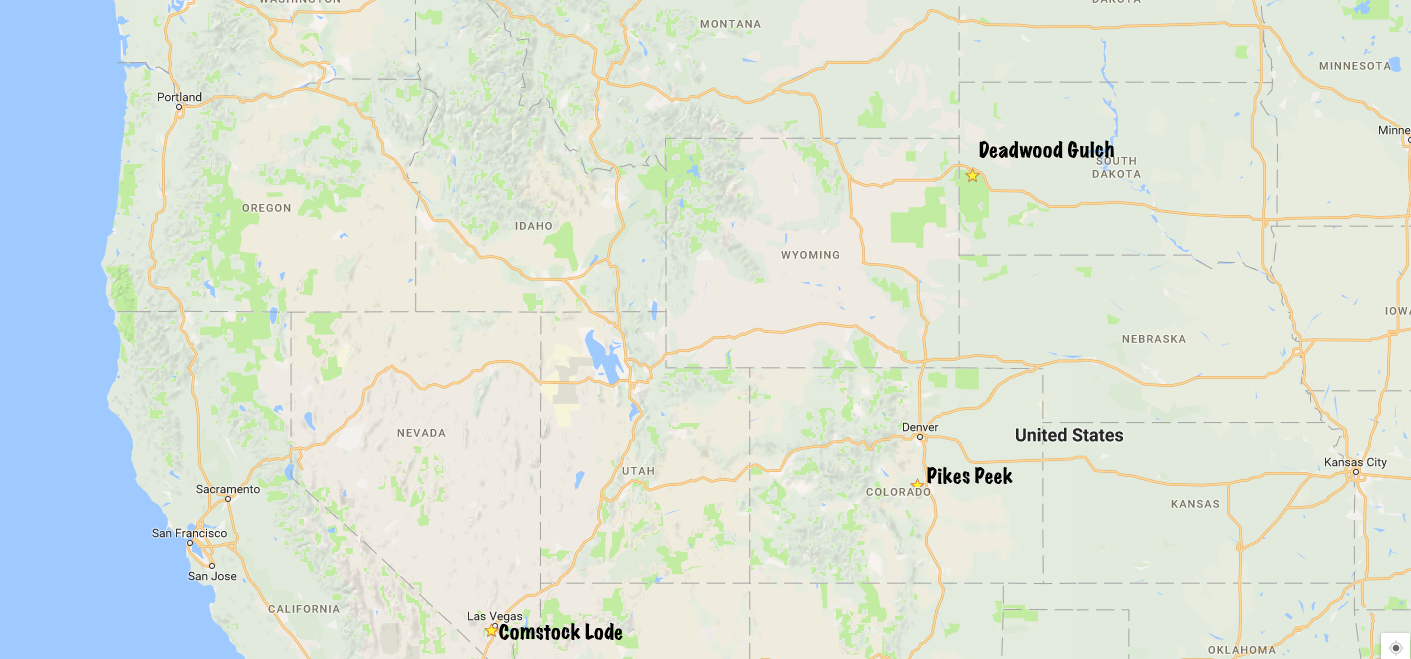
4. Why did large businesses usually benefit more from gold and silver mining than individual prospectors?
If I would go into a mine and search with my friends for gold, find gold and mine it, I would have more gold than if I would mine alone. Same thing with large businesses and individual prospectors. The large business has more people to work and collect, an individual prospector has only himself. Sure if he collects everything he collects is his, but the larger businesses have more people so the gold is faster in their hands and gone before you could even start.
Cowboys and Ranchers
1.
Vaquero - a cowboy or herdsman.
Long Drive - driving cattle long distances to a rail road depot for fast transport and good profit
Joseph McCoy - was a 19th-century entrepreneur famous for promoting the transport of Longhorn cattle from Texas to the eastern United States.
2. What problems brought an end to the Great Cattle Drives?
Cattle drives in the western United States largely ended in the late 1800s due primarily to a combination of barbed-wire fences and the new convenience of the railroad. The open range was increasingly blocked by fences as sheep herders and cattle ranchers closed off their land to prevent encroachment from other cattle. Meanwhile, shipping by train proved to be faster, safer and less expensive.
3. Where did most of the cattle trails start?
Kansas and Nebraska
Cattle drivers ended near____?
Farmers on the Plains
1. How did the federal government encourage people to settle the Plains region?
They encouraged them to settle by providing farm plots.
2. Describe the problems faced by farmers on the Great Plains.
Rain was not very consistent. There were things like locust swarms. Even the ground was hard to plow because of how thick the roots of the prairie grasses were. A second set of problems was connected to the fact that the Great Plains were far from the populated areas. There was very little wood on the Great Plains and it was hard to get any from the East. This meant people had to do things like living in sod houses. They had to do without much fuel and without many kinds of foods that were available in the East.
3. In what ways were farmers victims of their own success?
They faced low prices for their output, subsidies prop up their income.
Timeline World War 1
